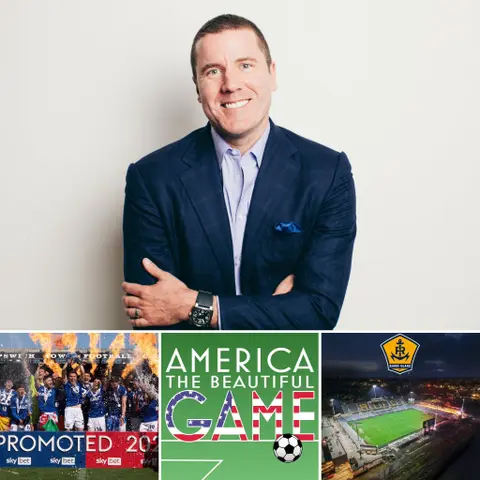
Ed Sheeran, Premier League promotion and relegation and the growth of US Soccer. Brett Johnson, Rhode Island FC and Ipswich Town owner

 Apple Podcasts
 Spotify
 Overcast
 Castro
 PocketCasts
 RSS Feed
 I sit down with Rhode Island and Ipswich Town owner Brett Johnson to discuss the translantic growth of the game.
We discuss the joys of promotion and relegation with Ipswich, Ed Sheeran’s authentic love of the club and spending to stay up.
He tells us about taking Rhode Island to an Eastern Conference crown, the growth of the game in America and why the USL has got the model right.
Brett also talks about the World Cup, developing young players and his favourite games to watch.
SPEAKER_00
Welcome to America the Beautiful Game, a podcast about soccer in the United States and its relationship with Europe. Each week, Dan Rutstein, president of Orange County Soccer Club, sits down with a guest to talk about a different aspect of the beautiful game on or off the field.
SPEAKER_01
Welcome back to America the Beautiful Game, and I'm delighted to have on a show a man bearing in mind the premise of the show is football on both sides of the Atlantic, a man who has very strong interests in football teams on both sides of the Atlantic. Welcome to the show, the CEO of Benevolent Capital, Brett Johnson.
SPEAKER_02
Thank you, my friend. It's a real honor to be here.
SPEAKER_01
So uh you're the owner of Rhode Island, who are one of the certainly more progressive clubs in the USL, and I want to talk about the growth of that club and the stadium there. Um, but also uh obviously you have a big interest in Ipswich Town. Um so I think given the Premier League season has just kicked off and everyone's very excited about it on both sides of the Atlantic, let's let's start with let's start with the Premier League stuff. So um obviously we're trying to get promotion relegation into America. Ipswich Town are a great example of a team who've enjoyed the benefits and disbenfits of of promotion relegation. Tell me how exciting it is to be back in the Premier League and also I guess what you've learned from being in the Premier League before and then falling out of it quite quickly.
SPEAKER_02
Yeah, uh well, I say it all the time. Um I I don't think there's in sport, I don't think there's a better construct than promotion relegation. Um, games of consequence, certainly from a fan engagement perspective, is the best thing in the world. Um, there's no off night, you you have to show up and perform, and and it's ironic in a country like America, you know, relative to kind of uh what I'll call sort of the American ethos and that we don't have it, you know, that that said differently that so many teams and leagues are literally able to just dial it in year after year with no penalty, if you will. So uh, but I also, if you're in football, meaning soccer, I've always felt strongly you need to be in England. Um, I lived in England, I lived in London for five years. I had a front row seat to the religion by which the world reveres the other football, again, meaning soccer. Um and and specifically with Ipswich, we coveted when when Bear Kay and Mark Depper and I specifically sought to buy a club in England, we coveted the opportunity to do exactly what we've done, which is to find a lower-level club that had the gravitas, the stadium, the bones, the infrastructure, the history to be in the Premier League. Um, and and been with humility, been so blessed to see what we've been able to do in the five years we've been involved, three promotions, you know, granted one relegation, but two of the promotions out of championship to the Premier League, which I would probably put up there as about as tough a feat in sport as you will find. That's the that's the second toughest feat. This the toughest feat is to actually, once you stay in the Premier League, once you get to the Premier League, is to stay in the Premier League. But it's early days. I like the squad that we've signed over the summer. We certainly, as as most people who follow the sport know, or certainly the Premier League, we we spent some money because uh we're we are committed to staying up, but so much easier said than done.
SPEAKER_01
Yeah, so I mean, ironically, this week I was listening to one of my favorite football podcasts. It's called the Soccer Boardroom, um, where Christian Perslow, who was a chief executor at Aston Villa, was talking about what it what you need to do to stay in the Premier League. So you have to spend 120 to 150 million on players plus another probably 30 million on your wage bill. And it doesn't guarantee anything, but that's just the sort of almost the minimum you have to do to compete. Um, and if you can survive that first year, it does obviously get easier, but there's plenty of reasons why you might not survive that first year. What do you think you've learned as a club, given how recently you were up and down before? What will you do differently compared to last time?
SPEAKER_02
I I think the last time, and and in some respects rightly so, there was an incredible amount of loyalty to the players that were largely with us from League One that helped us to achieve back-to-back promotions. And so if you look at our opening game two seasons ago in the Premier League, we opened against Liverpool and we lost 2-0. Nine of our 11 starters were with us from League One. Uh, you know, and you can pull off every season, you'll see a League One team knock off a Premier League club in a Carabao Cup or a uh FA Cup, but it's a one-off. You know, it's you can't do it over a 38-game season with any consistency. And so I think this go-around, there was much more of an uh of a candid reflection of the fact that what got us back to the Premier League was not going to keep us in the Premier League. And and again, with the utmost respect to championship, which I do believe ounce for ounce is about as competitive a league as you'll ever find. Um, the the next jump up to Premier League day in and day out is is literally a whole nother league.
SPEAKER_01
So people own soccer clubs for different reasons. They do it as obviously a financial investment, they do it as a passion project. I know you're I mean you're based on the West Coast, so for you to get to Ipswich is door to door a probably 18, 20 hour trip, um, if not more. Um how do you sort of obviously uh you know you're doing this for business reasons as well, but you know, as somebody who loves football and enjoyed loving football when you lived in London, like when you look at the schedule, particularly now you're back in the Premier League, are you flying back for the the home games against you know Liverpool and Arsenal, or are you just watching on TV at seven in the morning?
SPEAKER_02
Yeah, I I'm uh I'm on the TV most of the time. I mean, I go over for all of our board meetings. In fact, I'm flying over for a board meeting next week. Right right after we have our USL board meeting, I fly to London. Um but no, with a wife and three kids and and with with a strong desire to stay married. Um, I can't, I just can't uh but the reality is the club doesn't need me there in person. You know, we the smartest thing I ever did, and USL deserves credit, is I met Mark Ashton, who's our CEO, but he came to a USL board meeting and he was at Bristol City and he gave a presentation on English football. And I was very quick to befriend him and kind of say to him, look, I if I ever get a chance to buy and own, you know, to invest in a club in England, I'm gonna be calling you up. Because I could I could tell that he was a world-class CEO. And so that's exactly what I did. So so Mark Mark deserves a disproportionate credit for everything that we've done since we've acquired Ipswich. I I, if you will, with humility, I deserve credit for setting it in motion, having an interest in buying a club, getting a partnership with the pension fund in Arizona to give us the initial capital to do so. But I know what I know, and I and I don't know how to run an English football club, and I never want to learn how to run an English club. So, you know, I I think smart money goes to die, particularly in foreign leagues, if you don't get someone who really speaks the language, who like a Mark Ashton, who understands and he'll forget more than I will ever know about English football.
SPEAKER_01
Yeah. What given your marital situation, what does it take to get you over there? Is it uh obviously, you know, a playoff final?
SPEAKER_02
But promotion games. I've been to all three of the games that we've been fortunate to win and get promoted. So I was at a you know, all those I I um but but again, uh yeah, just just any any really big games of note, or if I have one a large investor and there's something of meaning to it, but again, uh there I love there's nothing I enjoy more than going to Portman Road. It's a bucket list experience. I have a great track record when I am there. I've only seen us lose once in all the years and five years of being there. I've only I've only witnessed one loss. So that's a that's a pretty good track record. But um, but uh, but all that being said, look, I you know, Rhode Island, you know, I I make it back to Rhode Island for very, very few games on a on a relative basis. So I I have a history in the 12 years I've been in the space of kind of just having to watch a fair bit and cheer from a distance with these clubs.
SPEAKER_01
Um so obviously, people over here in America, a lot of them have picked a Premier League team and they support them. I imagine not a huge number of those people will have picked Ipswich Town. Um, and I was talking to someone the other day, and I said I've got the one of the owners of Ipswich Town coming on my podcast, and he's like, isn't that the Ed Sheeran Club? So, I mean, you know, I spoke to see one of the officials at the USL, who you know well, Lee, he was telling me about how the sort of deal came about where Ed Sheeran ended up having his record label on the front of the shirts. But in terms of sort of the relationship with a global superstar being a real fan of your club, you know, the pictures of him in tears um uh you know while watching the team get promoted, how helpful is that, both in terms of what it means for building community over there, but also name recognition over here?
SPEAKER_02
Yeah, you can't you can't properly describe it. Um I I highly recommend anybody who look looking to buy a uh football club, try to find a club where uh a global music icon and and you know happen to have been born close by and has adopted the club since birth. Um, I mean the reality is when we bought the club, we we knew that it was Ed Sheeran had an affinity, but at the time he had no relationship with the club. And we were very quick to kind of talk about the fact that look, we have got to figure out a way to to to find out if he would want to be a bigger part of this. And and some of that had already been under works with someone in the sponsorship group, but we kind of helped take it to the next level. And and again, Mark Aston deserves a lot of credit in terms of cultivating the relationship with Ed. Um and and look, it's an exciting time in sport, but there's a big difference, respectfully, to like a celebrity athlete that has no historical connection at all to a team, you know, make announces an investment. Like that's just not the same level of candidly of someone like Ed Sheeran who is going to reschedule things around games, do everything possible he can be. He's got his own suite in the stadium. Like his depth and breadth of his love and loyalty to the Tractor Boys is as authentic as you will find from anybody, you know, as a fan on this planet.
SPEAKER_01
Yeah.
SPEAKER_02
There's nothing there's nothing contrived about it. And I'm not again, I'm not trying to say, but in general, I'm not quite sure. And I don't mean to pick on her, but I'm not quite sure Martha Stewart is like a diehard Swansea fan since birth. Like I don't, you know, I don't think she's and again, it's great. I and I'm not, and I think it's fantastic when the Martha Stewarts of the world start to get involved with football. I want to make that very, very clear. It's outstanding. I love it. But uh there's a big difference between, you know, one A versus B, if you will.
SPEAKER_01
Yeah, and look, obviously, it's um there's a lot going on nowadays with celebrities, particularly American celebrities, buying into teams. And yeah, I don't know how often Snoop Dogg has hung around the pubs in in Cardiff. Um, so I think it is different. And I remember I when I lived in Dusseldorf, there was a local rock band called uh the Totenhosen, the Dead Trousers, and they were from Dusseldorf, they'd been to every game, and then when the club was in the third division and were running out of money, they beat went as front of shirt sponsors and basically saved the club. But that wasn't you know a social media celebrity investment, that was like the Ed Shiram one, you know, it was real, and I think that you look at Man City and and the Gallagher brothers, it's the authenticity sets it apart. Um, and that's what makes it so special. Yeah, yeah, totally. Um, so let's talk about America. So Rhode Island, um a new $130 million stadium. Um, obviously, you had an incredible season on the field when you started. USL is uh probably in its best position in terms of uh games uh you know broadcast, the number of you know, talk around promotion relegation, new teams in the league, new stadia being built. Talk about sort of why Rhode Island and why you're excited about it.
SPEAKER_02
Yeah, so my my arc with USL started obviously in Phoenix. I I bought the predecessor team to Phoenix Rising called Arizona United. At the time, my business plan was to actually take that franchise up to MLS. At the time, USL and MLS were effectively, for all intents and purposes, married to each other. They were partners. The MLS reserve teams played in USL. But more importantly, for my business plan, if you had the right USL team in the right market and you wanted to pay an expansion fee, you could go up to MLS. Um the trajectory for me, and I started to recognize that one, USL and MLS were getting a divorce and they were going to no longer have MLS teams in USL. And then two, respective to my balance sheet, when the franchise fee was going from 60 million to 600 million, it just I got priced out of any type of realistic pathway to be an owner in MLS. And I started to really covet the opportunity to find the right market with the right stadium. And for a lot of reasons, Rhode Island started to stand out. It has great demographics. It lost a iconic baseball team, a minor league baseball team that picked up and left. I had ties to the state because I went to Brown University, which is in Providence. Um, so all all the all the planets were aligning for me. And I started to look, and I can't really I shifted out of really my equity out of Phoenix, and I started to invest in making Rhode Island a reality. And I took a page largely from Louisville's playbook where I saw the catalytic impact that a soccer-specific stadium in the right location with the right team had. And that was a that was probably the biggest coup was figuring out a way for an expansion team in a smaller market to build and finance a new stadium. And what I'm really pleased with is one is how well we've been doing with that, but also I think it's provided a great deal of motivation to other markets, not just Rhode Island, but I think Louisville, Rhode Island, you know, you start to see like what's going on with Sacramento and New Mexico and OKC and Pittsburgh and Detroit. And I mean the list goes on and on. So in the next five years, the the the quality, the transformation of USL with the advent of ProREL and a third league, you know, USL I think is going to really establish itself as in a whole nother level uh from top to bottom.
SPEAKER_01
And obviously, but you know, you and I uh have a level of bias here because we are in the USL. Um, but it's interesting, as you say, now the franchise fee is five, six hundred million for an MLS team. How many you know Americans are choosing to buy a team in in Europe rather than because really, if that's your franchise fee and in a stadium and setup costs, you're well over a billion, um, which is why you can afford to buy even a small Premier League team for a third of the price of an MLS franchise.
SPEAKER_02
Bill Foley and Bournemouth. Bill Foley is that case study. He he was literally given the option to buy an MLS franchise in Vegas. He already owned the NHL team, he was the perfect target. And and he did the math, and he was like, We why don't I just pick up Bournemouth? And and it's been amazing to see what he's done with that with that bill. And now he's gone on and bought clubs elsewhere anyway. So he's he's my quasi hero when it comes to you know what he's done.
SPEAKER_01
Yeah, a hundred percent. Um what does it look like, do you think? You know, if promotion relegation comes in in what is two years' time now, what does two division, I mean, this whole like division one, division two thing that only Americans understand. In Europe, they don't understand you know, they're in one and division two are the names of the league, not the the ranking and a tier system within a federation. But how does it work? I mean, America's a big enough country, presumably, for MLS to thrive and USL Premier to thrive. What's what's your view on how that that looks like in the future?
SPEAKER_02
I think that's right. I I mean again, my I would look at it and say, I think MLS, rightly so, is gonna dominate what I'll call the major markets: New York, Los Angeles, you know, I guess Chicago, Boston. I mean, again, you got kind of go through. I mean, yes, they do they do they have some exceptions, like a Kansas City, you know, for sure. And I think USL can, should, will thrive in what I'll call an incredible ecosystem of maybe smaller secondary emerging markets. I mean, look what's going on in Boise, look what's going on in in Portland, look at the what you guys have established in Orange County, New Mexico, obviously what we're doing in Rhode Island, what John's doing in Louisville. So I think there's a very bright future for us to coexist. And I think we should coexist. I say it all the time: anyone who's in this space is a friend of mine. And I and I never have any motivation, if you will, to malign MLS versus USL. I just feel strongly USL has the ability to adopt promotional relegation, and USL should try to be everything that it can be for its ownership group, for its fans, for the players, et cetera. And if we do it right, I think we can develop one of the greatest development leagues in the world. Like I don't, from my perspective, I don't aspire to see USL, and I don't think it's realistic to view USL as going to compete with the big, big leagues. But I think USL can be one of the greatest places for young players to get quality, time, and talent and go on to do bigger and better things. And and conversely, I think the average player will not view the same thing about MLS. That that, in many respects, will view that that's an impediment to their long-term career. You're better off going into USL playing for Orange County and then going to Portugal than getting locked into an MLS system where you're going to be really struggling to get out of that ecosystem more often than not because MLS and their minds are trying to compete with the top leagues in the world.
SPEAKER_01
Yeah, I think that must be right. I mean, we you know, we've sold 11 players to Europe.
SPEAKER_02
You guys have been incredible. Like I honestly seeking, I aspire to start to do what you guys have done.
SPEAKER_01
But if you're a 16-year-old in an MLS reserve team, nowadays, particularly the way MLS is developing, they're more likely to pay lots of money to bring in somebody who won the World Cup 10 years ago, then give you a chance. But in USL, you get to play in front of, you know, for us it's not as big, but they can play in front of 10,000 people, get all of that development in the move.
SPEAKER_02
So if you're playing in Columbus in the reserve team and it's an empty stadium, you know, it's and you're finding your pathway blocked to the first team, then you know you have to question is there a better route? And I would say USL is a better route for you for you under that scenario, especially if you're a young American player.
SPEAKER_01
So I one of the things I've tried to do at Orange County is uh bring in some of the elements that work in England to our club to sort of add the football to the American way of watching sport. Um and it's always fascinating to me some of the differences that exist between the two countries in terms, you know, I was back at Plough Lane, the home of the team I support, AFC Wimbledon, who are still grateful for you uh buying Ali uh from us um in your promotion season three years ago. Um they shut the club shop at three o'clock because who's gonna buy a shirt during the game? If I if I told my owner I'm shutting the club shop during the game, I think I'd probably get fired straight away. And it's really interesting, you know, there's there's so much that's shared, that's so much that's different. Given where you sit as a you know, you're not involved in the day today in either club, but sitting from your position above of clubs in different countries, and I know Ipsit are a Premier League club, but they're also they were a League One club when you started. What do you think the Americans can learn from the English and the English can learn from the Americans in terms of game day experience, how clubs are run, and so on?
SPEAKER_02
Yeah, it's a great question. I mean, uh my quick answer is I think Americans treat sport more as entertainment. Um where I think football in England i is, you know, it's I guess it's the the adage, you know, that it's you live and die by these teams, if you will. Like they're literally ingrained from birth in your DNA. And so there's just a massive difference in the psyche of pro the average fan. And so in general, like I think about the level of support that a lot of these clubs in England and other markets get, kind of regardless of how good or bad the team is, or regardless of how good or bad the ownership group is. But the reality is that comes, that only goes so far. Like when we bought Ipswich, it was on the wrong side of League One, so third level, it was staring down a potential relegation to League Two. And the fans were starting to literally write the club off. Now for love or money, you can hardly find a seat in Portman Road. You know, um, like the the support base is so inherently strong there. Like if you have a Tuesday night care about cup game now or whatever, whatever it be, Wednesday night, we're gonna sell that out. Like, and it's staggering. Where on the flip side, I think in the United States, in uh Rhode Island, Orange County, we have to, it's hand-to-hand combat to get people to come and taste the product, to become season ticket holders, become fans, to build that up because it's just you do not have 150-year history where you've been the anchor for that community. So, anyway, it's a it's a long way of saying it's so different between the two, but I think there are certainly elements that probably England can benefit or foreign markets could benefit relative to an American approach. And I think there are some elements where again, I just um if I could bottle that DNA of the average supporter of Ipswich and inject it into the average Rhode Islander, if you will, and it and it exists. Like you've got those fans, we've got those fans that where and you just look at them and you're like, man, I just wish I could clone you. Like I I want I want 10,000 of you instead of a thousand of you.
SPEAKER_01
One question that you're uh as well placed to answer as anyone else is there's this debate of uh how would Americans' teams do in the British system in the sense of you know, is MLS uh Premier League championship, is USL League One? What would you say a good USL team? Is that League One level, League Two level, on the championship?
SPEAKER_02
League two at best, to be honest. I I think the average championship club would destroy uh the average MLS club in general. Um I I I think I think MLS clubs would probably be fine at a League One in general like they they would, you know, and some some MLS clubs would probably do very well in like a league one, if you will. But again, I I would I would say is I am I am positively amazed with just the depth and breadth of how good English football is. Like, like you you you watch games in the National League and see really, really good quality players. And again, that's what makes the FA Cup and the Carabao Cup interesting because you will get those matchups where you're like, wait a second, am I watching this? Is this team really going head to head with Manu? And they're three, four leagues apart from each other, and they are sometimes not all the time, but sometimes, or again, if you watch the highlights, you'll be hard pressed to understand which was the Premier League team in there. So, but again, I so I just don't think but I I think MLS is getting better every year, USL is getting very better every year. But again, there is there is the day in and day out uh like pressure of being in championship, like what the medal that you have, where again, by and large, there are a lot of MLS clubs that can literally dial it in, that there's no consequences, if you will. Um, and and again, in general, I I think if you match them up with each other head to head on a consistent basis, I'll I'll tip my hat to England every day of the week, by and large.
SPEAKER_01
So I was gonna ask you about Cups, because you know, um see, I think Wim would have knocked Ipswich out of the FA Cup a couple of years ago. But the um cups are uh in England, as you say, amazing. A non-league team could potentially beat a Premier League team. Um and for a club like Ipswich, they're not gonna, with all due respect, you're not gonna win the Premier League, but you could win a you could win a Carabael Cup, um, or give your fans a day out at Wembley in an FA Cup semi-final. So and obviously now we've just had the announcement that MLS teams are gonna play in the Open Cup properly. So tell me your sort of experience and view of the cups in in England and Ipswich position, and also now it's back on track in America, how that looks for Rhode Island and football in general.
SPEAKER_02
Yeah, again, in in England, the reverence for in particular the FA Cup, you know, and and Ipswich is a is a holder of of you know that fine hardware. Um there's some there's something special about it. And and it, but again, there's also the ability for lower-level teams to really punch above its weight class by and large. And in the US Open Cup, I mean, you probably know the history much better than I do, but what was it, Rochester or someone was like the last time, you know. So anyway, there have been some examples of it, but not many. But in general, I think for any of us who's in the sport, we should have respect and reverence for the importance of these cups, the U.S. Open Cup. And that's why I was disappointed with MLS making a decision to kind of walk away from it. I'm pleased, I guess it's come back and they're now committed to it. And I think that's very, very positive. I mean, there's an irony to the fact that it's called the Lamar Hunt U.S. Open Cup for MLS to effectively turn their back on arguably, you know, other than maybe Antschutz, the greatest owner in the history of MLS. So, anyway, long way my saying there's something beautiful about Cup games. There, you know, the you know, David versus Goliath. And and USL has had some magical moments and you know, had some examples. I mean, Sacramento, did they make it to the finals? Am I getting that right? Yeah, yeah. Uh New Mexico, I think, had a Cinderella run early in there. You know, anyway, like I I recall watching some fantastic USL performances in US Open Cup, and long may it continue. So very happy that you're starting to see that. And also, I guess the benefit of what I'd also say are some probably amateur clubs that get access to compete in the US Open Cup and you know can have a couple uh you know great nights out. And I think that's unbelievably positive for the sport and something that we need to celebrate and we need to support.
SPEAKER_01
So um I completely agree with all of that. So a couple of sort of uh I guess more personal football questions for you. So what is the best game of football you've watched live that you weren't an owner of either of the team's in? And then also, what's the uh the best game you've been you've been to live which you had a stake in?
SPEAKER_02
So that's great questions. Um so first of all, the two most recent uh games was Cape Verde versus Argentina and England versus Mexico. To me, those were the two games that stood out from the World Cup where where I was I was just shaking my head in terms of oh my god, how how compelling is this are these games right now? Um and then you know, I there have been countless memories with Ipswich specifically. I mean, Phoenix Rising, it was the last day I was really associated with Phoenix Rising, but Phoenix Rising going on its on its playoff run and then winning the championship and coming back in against Charleston Battery. If literally we scored in the 89th minute to tie the game up to put in an overtime, and then we were down like 3-1 in penalty kicks and came back anyway. Like, you know, again, it's one of these games where you're like, there's nothing like sport where we're like one penalty kick away from it's over to like the next thing you know, two minutes later, it's we've actually won the cups. Like, so you know, that's a magical moment. Any of the promotion games for Ipswich um have all been magical. Um, and and again, Ipswich has had some battles with some big, big clubs where, you know, like some matches against Southampton and and others where you just uh Norwich recently, we had a you know, we finally kind of got the monkey off our back because it's been a long time since we've been able to beat our rivals, and it's been a long time winning on the road against them. So, you know, that was a nice win this past season. So, you know, there's nothing like sport. There really, there is nothing like uh, and the world needs it more than ever. And I say, you know, to ever I have a, you know, obviously over the years, I have a lot of investors that have joined me on this journey. And, you know, there's a lot of place to put your money and there's a lot of place to put your time, but there are few things that you can get as much joy and utility out in terms of being involved with the right sports platform that's doing the right things on and off the pitch, um, and also just the joy of sharing it with family and sharing it with friends.
SPEAKER_01
Yeah, absolutely. So um I guess penultimate question. I'm conscious of your time.
SPEAKER_02
By the way, I'm sorry, I should have mentioned Rhode Island winning the Eastern Cup Championship was was great. I mean, we we fell short in the finals, and all credit to Colorado Springs for that. But anyway, that was also a magical run, you know, in the in the first season. There's just so anyway, so that was I just want to put that footnote before someone from Rhode Island was like, wait a second, how did you forget us?
SPEAKER_01
So yeah, no, that was a magic. It's I mean, I think I mentioned before, quite in one of sports from a personal level. Your your head coach, Carno. Um, when I was a sports journalist in Bermuda, um, I both wrote I interviewed him many times, and I think I refereed the uh he played this game where he played half the game for the Bermuda national team and half the game for New England Revolution just before his transfer. And I was uh I was the I think I was the linesman in that game. Um, and then we bump into him on the sidelines when uh when you were playing us a couple of years ago, which is uh it's great. He's such a nice guy, and I think it's it's actually great for Bermudian football for him to be doing so well over here because he's sort of probably the biggest name since Sean Gotha.
SPEAKER_02
I I I'm excited for Kano. I'm excited that we gave him the chance to step up and be head coach, and you know, Ipswich has a good history of giving chances to you know new coaches with good track records. So, but he he's a great coach, a great human being, which is to me you know the most important thing to start with. But yeah, it's and it's been it's been great to see what he's done with it. And it's good been, but that's again why I'm such a big advocate and fan of USL, because of what it provides to coaching opportunities, what it could provides for player opportunities as well.
SPEAKER_01
Absolutely. So um, so sorry, penultimate question. What what does success look like this year for a Ipswich town and B Rhode Island?
SPEAKER_02
Ipswich is staying up, you know, they're like 17th plays or better.
SPEAKER_01
Yeah.
SPEAKER_02
That that seventeenth or bust, you know, like again, I'd love it to be, but we just the difference between 17th and 18th is literally uh hundreds and hundreds of millions of pounds. Um, so there is no that there is no number two on it. Number one is doing whatever it takes to find a way to stay up. And then uh with Rhode Island making the playoffs is a requisite, you know. I think we've got a couple games in hand and we're sitting in seventh place, so nine games left. So I think I think we should be able to figure out the playoff piece. I obviously we all love a home playoff game to start with, you know, mixed. So hopefully we get fourth or better, but we'll see. But again, I I think it's an achievement every year to make the playoffs in USL. I think overall, the depth and breadth. I think about like the team that I'm blessed to be a part of now in Rhode Island, and I compare it to like my first team with Arizona United, like the quality of the league and the players and the athleticism, the depth and breadth of talent has got is so much better than it was. Again, I'm not trying to take anything away, but I think I think most people who come and watch a USL game uh understand that we were very, very impressed. And in general, the gap between the average USL team and the average MLS team, put it with the exception of some, you know, um some of the guaranteed contracts on the MLS side, if you will, some of the but in general, there's not a massive gap between the two leagues.
SPEAKER_01
No, I think that's right. And you know, some of my English friends don't really know how it all fits together. And I when I tell them that Didier Drogba's final goal as professional footballer was scored at R Stadium, that gives a sense of of where things are.
SPEAKER_02
That was a good memory that game. I remember for you.
SPEAKER_01
It was before I joined the club, but our fans are still upset about him scoring, and then I think you guys ran on the field afterwards.
SPEAKER_02
And uh I'm sure there's still some some lingering, yeah.
SPEAKER_01
I think there is. Yeah. Um, so last question, ask every guest this question. Um, actually, you again it'd be interesting given your unique perspective. If you could change one thing about soccer in America, what would that one thing be?
SPEAKER_02
Well, I would say I I'd answer it soccer globally, is that there's too much of it that's not sustainable. You know, the reality is it's it's not sustainable in the Premier League that clubs have to spend hundreds and hundreds of millions of pounds in the transfer windows just to compete. It's it's not sustainable that clubs in championship, you know, it's relatively have to spend similar amounts of money to try to get up to the Premier League. It's not, you know, too much of the sport, and I don't I don't have an answer for it, but too much of the sport globally, and you know, and you can almost point to every single league in the world where you have the haves and the haves nots, and you have the ones that you know are fine, but then the ones that are struggling. And and let's look at Wrexham for a second. It's been incredible what those guys have done with Wrexham, right? Incredible. But not enough attention is on the fact that if not for them, Wrexham's gone. Wrexham goes out of business. Like there was, you know, this this was they were a hair's breadth away. And so that was a Hollywood story that these guys came in and saved it. But there are a lot of other Wrexham's like there that are not going to get a rock, Ryan Reynolds or McLean to come in and save the day. And so so that that's where I feel like uh there has to be some form, and again, I have no answer for it. I I would love to try to figure it out, but there needs to be some level of rationalization because otherwise, at some point, the music likely will stop and there'll be some some form of a reckoning. And it's not healthy if there's too many clubs that are bleeding too much cash and too many leads.
SPEAKER_01
Yeah, no, I think I think that's right for, as you say, for this country and for you know, in the I think in the in the football league system in England of the 92 clubs, I think something like 83 of them operate at a loss, and the only ones who don't are ones who've had some big transfers. Um, because it is it's it is an unsustainable business model. Um yeah. Very good. Look, Brett Johnson, owner of Ipswich Town and Rhode Island, thank you very much indeed for for joining our show.
SPEAKER_02
And good luck for your season, it's such a pleasure to talk to you. I really loved it, and uh good luck, good luck with the rest of the season. Hopefully, hopefully we see each other in the finals.
SPEAKER_01
Yeah. Cheers, Brett. Thank you very much.
SPEAKER_02
Thanks, my friend.